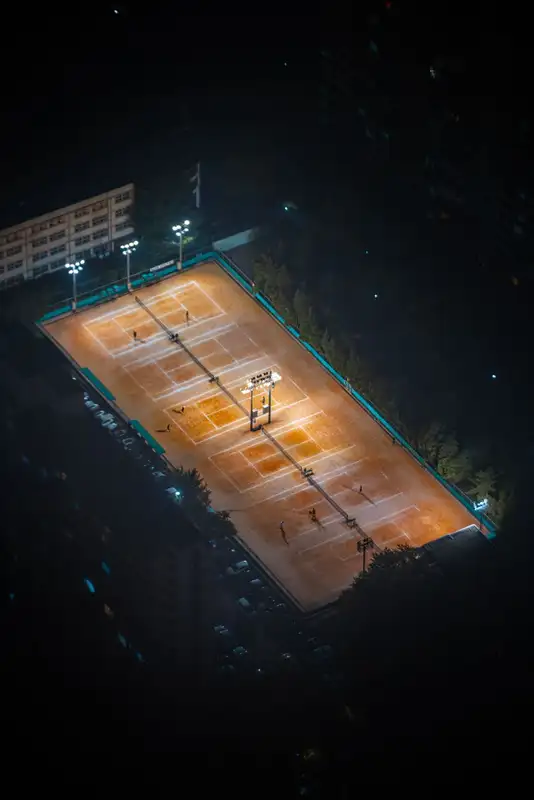
Participating in sports is essential for a healthy lifestyle, whether it involves swimming, football, basketball, badminton, or tennis. Each sport, whether played indoors or outdoors, necessitates specific lighting designs tailored to its unique environment. For example, the lighting setup for an indoor tennis court must harmonize with the architectural elements to provide optimal visibility for players.
A standard tennis court covers approximately 670 square meters, typically measuring around 120.08 feet by 60.04 feet, and is enclosed by a backstop or wall. The court features various boundary lines that are crucial for gameplay, requiring comprehensive lighting across all areas. Uniform illumination is vital for players to maintain clear vision without obstruction. Given the fast-paced nature of tennis, where the ball can quickly become difficult to see due to glare or low contrast backgrounds, the levels and direction of lighting are critical for both the ball and the players. Proper placement and orientation of light posts are essential for ensuring good visibility.
Generally, a tennis court is outfitted with eight lights, each producing around 40,000 lumens, typically at 300 watts, to ensure sufficient lighting. However, the design must adhere to the standards established by the United States Tennis Association (USTA) and the UNE-EN standards.
Understanding Lighting Standards and Guidelines
The USTA and the Illuminating Engineering Society (IES) classify lighting levels based on the competition tier, which is divided into four distinct classes:
- Class 1: Professional level – 125-foot candles / 1250 lux
- Class 2: College and intermediate level – 75-100-foot candles / 750-1000 lux
- Class 3: High school and private clubs – 50-75-foot candles / 500-750 lux
- Class 4: Recreational use – 30-50-foot candles / 300-500 lux
The UNE-EN 12193 standard outlines the minimum lighting levels required for various competition classes:
- Class 1: International and national competitions – 750 lux horizontal illumination, 0.7 uniformity
- Class 2: Regional competitions and high-level training – 500 lux horizontal illumination, 0.7 uniformity
- Class 3: Local competitions, training, and recreational use – 300 lux horizontal illumination, 0.7 uniformity
Key Features of Tennis Court Lighting
- Anti-glare design to enhance visibility
- Anti-glare lampshades to reduce distractions
- High uniformity for consistent lighting
- Non-dazzling illumination for player comfort
- Comfortable lighting conditions to minimize eye strain
- Designs that prevent light pollution